
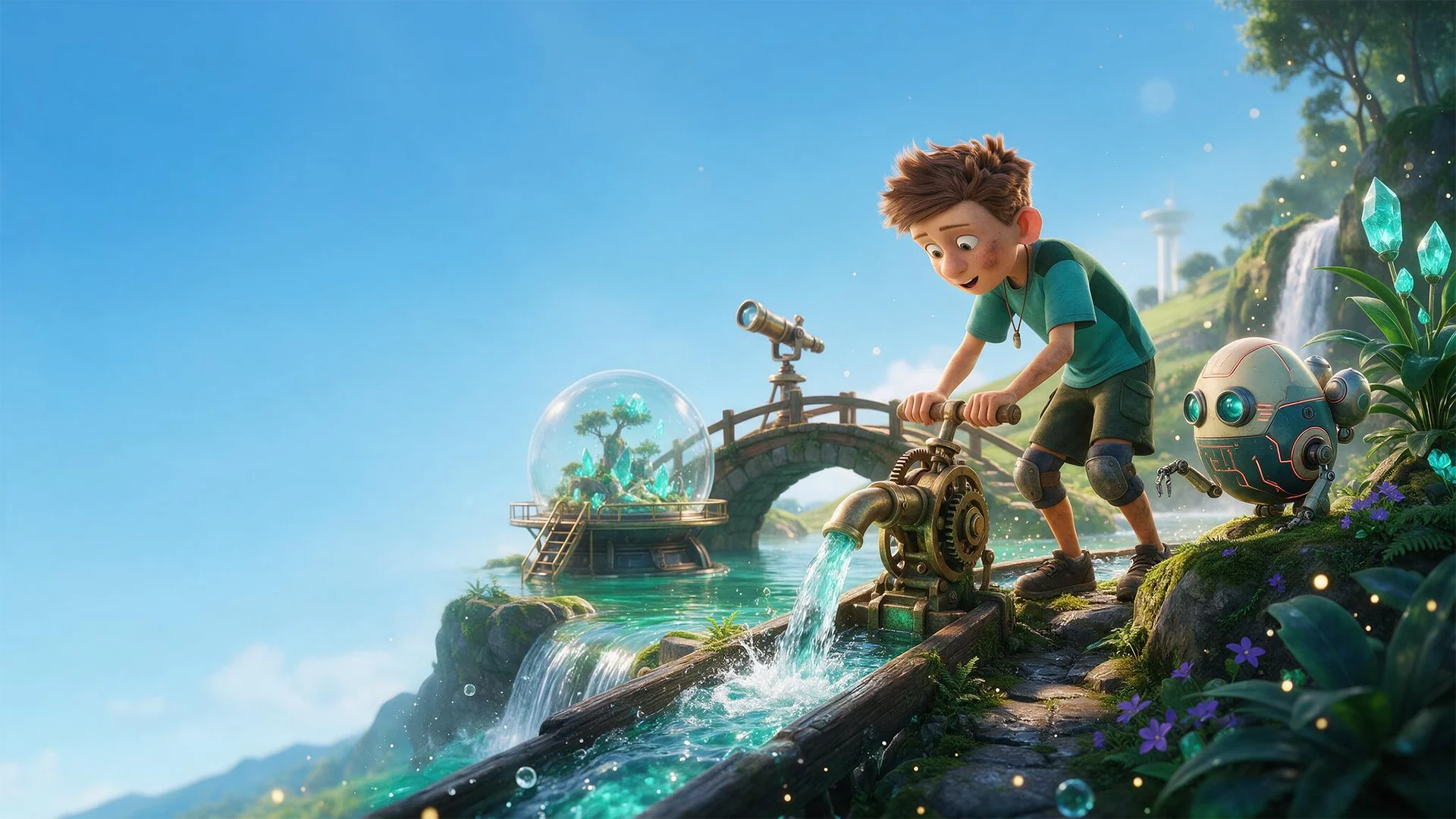
Learning is not simply about receiving information. We learn when we participate, experiment, make decisions and discover things for ourselves.
This is where educational gamification comes in: using the principles of games to turn learning into an active and engaging experience.
Combined with technologies such as Virtual Reality, Augmented Reality, 360° experiences and interactive applications, gamification opens up new ways of learning by doing rather than simply observing.
What is educational gamification?
Educational gamification means applying game-based principles to learning environments.
This can include challenges, objectives, decisions, rewards, levels, feedback, exploration or collaboration. But gamification is not simply about adding points, badges or leaderboards to an educational activity.
The real goal is to make the learner participate in the experience.
A well-designed gamified experience encourages people to explore, try things out, make decisions and learn from what happens next.
Why do we learn better when we participate?
There is a fundamental difference between being told something and experiencing it.
Interactive experiences can make learning more engaging because they introduce elements that naturally encourage participation:
Curiosity
When there is something to discover, we want to keep exploring.
Experimentation
Trying something, making a mistake and trying again can turn abstract knowledge into practical understanding.
Feedback
Seeing the consequences of our decisions helps us understand what works and why.
Challenges and objectives
A clear goal gives the learning process direction and creates motivation to move forward.
Discovery
Finding an answer ourselves can be much more memorable than simply being given the information.
Educational gamification brings these elements together to create learning experiences where the learner is not just a spectator, but an active participant.
Learning by doing: from theory to experience
Imagine learning about a Roman city through photographs and written information.
Now imagine being able to enter a digital reconstruction of that city, explore its streets, identify its buildings and complete challenges to discover how people lived there.
The information is still there. But now the learner has to use it.
The same approach can be applied to many different contexts:
- Understanding a scientific concept through experimentation.
- Learning a professional procedure in a safe simulated environment.
- Exploring a historical site through an interactive reconstruction.
- Discovering a museum collection through a digital mission.
- Making decisions in a simulated situation and seeing their consequences.
The technology changes depending on the project. The underlying principle remains the same: learning through experience.
Technology as an educational tool
Technology does not automatically make an experience educational. Its value comes from how it is used.
Different technologies can provide different ways of interacting with content.
Virtual Reality
Virtual Reality allows learners to enter an environment and experience situations that would otherwise be difficult, expensive or impossible to reproduce.
It can be particularly useful for simulations, training, historical reconstructions, scientific experiences and immersive educational activities.
Augmented Reality
Augmented Reality allows digital information and 3D content to be integrated into the real world.
This can transform a physical object, location or educational resource into an interactive experience.
Virtual tours
360° photography and video can provide access to places that are difficult to visit physically, allowing users to explore environments remotely and at their own pace.
Interactive applications
Web and mobile applications can combine information, challenges, multimedia content and interaction into accessible educational experiences.
The important question is not which technology should we use?
It is:
What do we want the learner to experience, discover or learn?
Examples of educational gamification
Educational gamification can be applied across many different areas.
History and heritage
Historical reconstructions can turn the study of the past into an exploration experience, allowing users to discover places, objects and stories interactively.
Science
Interactive environments can make scientific concepts easier to understand by allowing learners to experiment, manipulate elements and observe results.
Vocational training
Simulations can reproduce professional situations where learners can practise procedures and make decisions without the risks associated with a real environment.
Museums and cultural spaces
Games, missions and interactive experiences can encourage visitors to explore exhibitions and engage more deeply with their content.
Tourism
Interactive experiences can transform cultural and heritage information into journeys of discovery, both on-site and remotely.
It is not about turning everything into a video game
One of the most common misconceptions about gamification is that it means adding points, badges, rankings or progress bars to everything.
These elements can be useful, but they are not the essence of gamification.
The important thing is to create opportunities for exploration, problem-solving, decision-making and experimentation.
A good educational experience does not need to feel like a conventional video game.
The game is not the goal. It is the vehicle.
How do you design a good educational experience?
Creating an effective interactive learning experience requires more than choosing a technology and adding some game mechanics.
A good process starts with the educational objective.
1. Define the objective
What should the user learn, understand or be able to do by the end of the experience?
2. Know your audience
An experience designed for children, university students, professionals or museum visitors will require very different approaches.
3. Turn learning into action
Instead of simply presenting information, ask how the learner can interact with it.
4. Design the challenge
Give the user a reason to explore, make decisions or solve problems.
5. Choose the right technology
VR, AR, 360°, web applications or mobile apps can all be effective. The best option depends on the objective, audience and context.
6. Test and improve
User testing is essential. Observing how people interact with the experience often reveals opportunities for improvement that are impossible to identify during the design process alone.
From seeing to experiencing
There is a clear progression in the way we can communicate information:
Text → Image → 3D reconstruction → Interactive experience
Each step can add another layer of understanding.
A text can explain what a place looked like.
An image can show it.
A 3D reconstruction can bring it back to life.
An interactive experience can allow us to explore it, make decisions and discover it for ourselves.
That is where technology becomes much more than a visual resource: it becomes a tool for participation.
At Prexenz, we create experiences designed for learning by doing
At Prexenz, we develop interactive experiences that combine design, technology, content and storytelling to create meaningful ways of interacting with information.
We work with technologies such as Virtual Reality, Augmented Reality, 360° photography and video, interactive applications and 3D environments, adapting each project to its objectives and audience.
Because before deciding which technology to use, we ask a more important question:
What do we want people to experience, discover or learn?
The answer determines the experience.
Do you have an educational, cultural or training project that you would like to turn into an interactive experience? Let’s talk.