
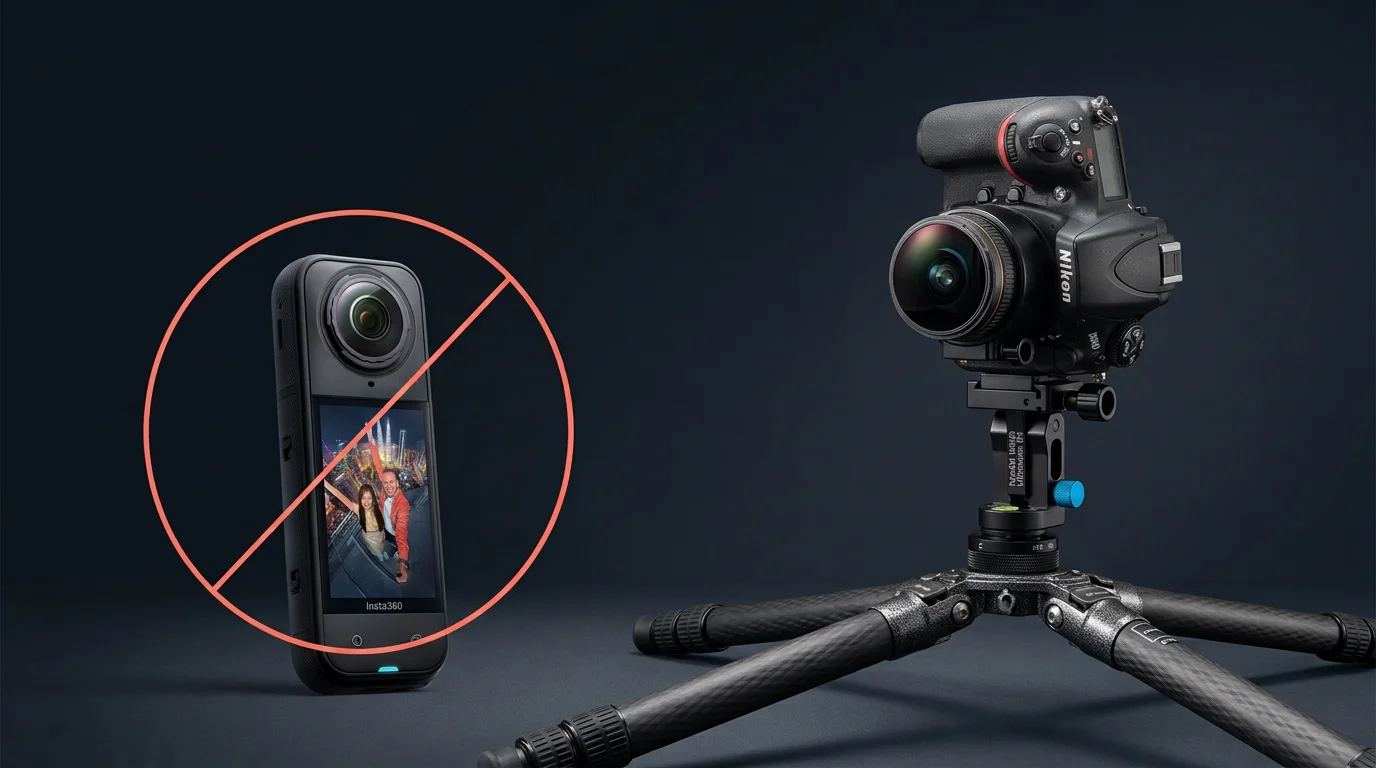
When doing things faster doesn’t necessarily mean doing them better.
In a world where a 360 camera can capture a complete panorama with the push of a button, at Prexenz we still use a DSLR camera, a panoramic head, and a manual HDR capture and processing workflow.
Why?
Because for us, professional 360° photography isn’t simply about capturing a sphere. It’s about making that sphere as high-quality, detailed and faithful to the original scene as possible.
1. A large sensor makes a difference
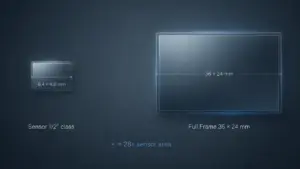
Conventional 360 cameras use multiple lenses and small sensors working simultaneously to build the complete image.
Our system starts with a DSLR featuring a large sensor, capturing multiple positions around the rotation point. At each position, we can also shoot a 7- or 9-exposure HDR sequence, capturing a much greater amount of information.
The result is a panorama with more detail, less noise and a much wider dynamic range, especially in interiors and scenes with high lighting contrast.
2. HDR without practical limits
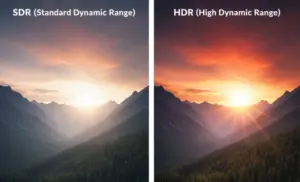
A scene can contain everything from areas lit directly by sunlight to extremely dark corners.
Instead of relying on an algorithm to automatically solve this situation, we can capture 7, 9 or more exposure levels and combine that information afterwards.
This allows us to recover practically the entire dynamic range of the scene and decide exactly how we want each area to be represented.
We don’t let the camera make those decisions for us.
3. Selective processing, not automatic processing
The RAW file is only the beginning.
A professional panorama requires development, correction and compositing. With our workflow, we can treat each area of the image independently: highlights, shadows, windows, artificial lighting, colour, contrast, noise…
The automatic algorithms in a 360 camera have to make these decisions for us and apply them more globally.
We prefer to control the final result.
4. More real resolution
Although today’s 360 cameras can advertise resolutions of up to 8K, a panorama created using DSLR photography can easily reach 12K, 16K or even more, depending on the lens and the number of captures.
But it’s not simply about counting pixels.
A larger sensor, high-quality optics, multiple exposures and careful processing provide more useful information per pixel, greater sharpness and less noise.
And that difference becomes particularly noticeable when the viewer is immersed inside the image through a VR headset.
5. The unavoidable stitching problem
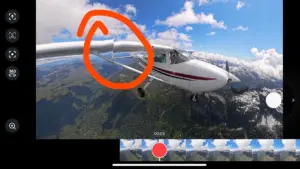
This is probably the most important technical difference.
A 360 camera needs to use multiple lenses and sensors that are physically positioned in different places.
But the light rays from a scene do not converge at exactly the same position for each lens: the entrance pupil of each lens is offset from the others.
When objects are close to the camera, this offset creates parallax.
Software can do an extraordinary job of hiding it, but it cannot change the geometry with which the scene was captured.
That’s why, with a multi-camera system, nearby objects can appear cut, distorted or show errors around the stitching areas.
With a DSLR mounted on a panoramic head and rotated around the no-parallax point, we can maintain the correct geometry of the scene and achieve stitching that is virtually invisible.
We’re not correcting an error after capturing it.
We’re preventing it from happening in the first place.
6. So why don’t we always use a DSLR?
Because every tool has its place.
For maximum-quality 360° photography, our DSLR system allows us to control the entire process and achieve the result we’re looking for.
But when it comes to 360° video, the situation changes completely. A DSLR would need to capture multiple images from different positions, which is incompatible with a moving scene.
That’s where 360 cameras become an extraordinary tool.
It’s not about always using the most sophisticated technology.
It’s about using the right technology for the result you want.
A 360 camera can create a panorama in seconds.
We take longer.
We capture more images, make more exposures, process the files and review the result.
Because when an experience is going to be explored in 360°, and especially through a VR headset, we believe every pixel counts.
Technology has made taking a 360° photograph incredibly easy.
Our job is to make it extraordinary.