
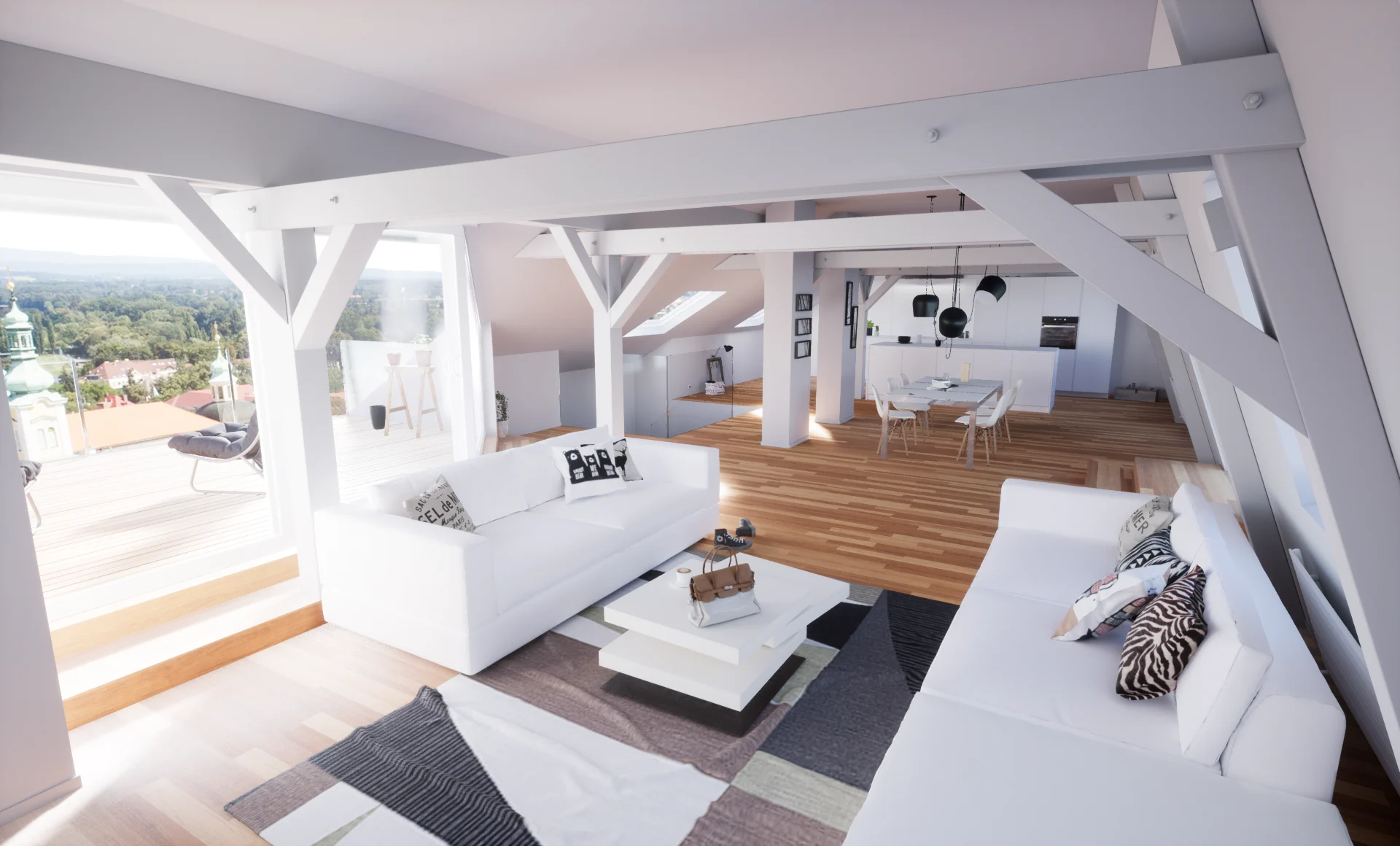
Selling off-plan has a problem that is not about marketing but about perception: most people cannot read a floor plan. They see square metres and lines, but they don’t see where the sun will fall or whether the sofa fits. And someone who can’t picture themselves living somewhere doesn’t buy.
What sits between the drawing and the show flat
Show flats work very well and have two well-known drawbacks: they cost a great deal and they show only one layout. Between the drawing and the show flat there is a wide gap, and three different things fit in it that often get confused:
- Stills. Cheap, quick and enough for a brochure. They show the finish, but they give no sense of space.
- An interactive walkthrough. The buyer moves through the home at their own pace, looks out of the windows and gets a real sense of the distances. It is the closest thing to visiting.
- A finishes configurator. The same space with different floors, kitchens or layouts. It also serves something unglamorous but very profitable: cutting down the hesitation that delays a signature.
What suits each stage
Early in the sale, reach is what matters: getting to a lot of people who are still comparing. A walkthrough published for the browser wins there, because it opens on a phone with nothing to install and can be sent over WhatsApp. Once the buyer is in the sales office, immersion matters: a headset in that office gets them to understand the space in two minutes.
And there is a middle case that gets overlooked: the home that is already built but empty, or awaiting refurbishment. Nothing has to be modelled from scratch there; the real space can be filmed and what is going to change laid over it. It is faster and cheaper, and we cover it in how to choose between virtual and augmented reality.
The detail that decides whether it works
Light. A walkthrough with believable lighting reads as a home; the same space badly lit reads as a video game, and the buyer disengages. Which is why it matters that the real project’s orientation and hours of sunlight are built into the model, rather than some generic light. You can see it in The Attic and in Andorra Loft: in both, what holds the scene together is the way the light comes in.
If you are marketing a development, real estate shows the kind of work we do, and you can write to us with the stage your development is at to work out what fits: starting to sell is not the same problem as closing the last few units.