
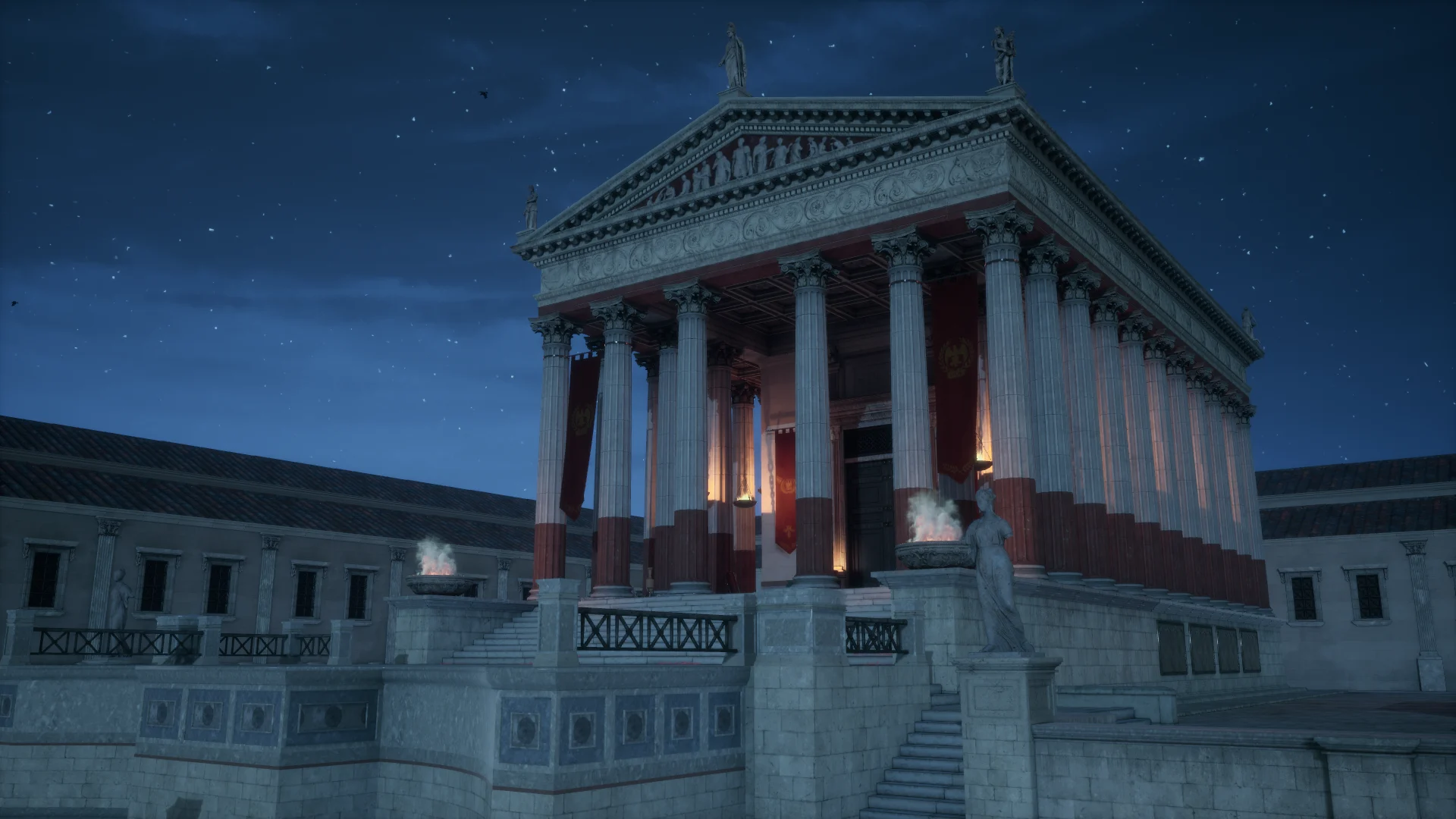
Of most of the Roman monuments still standing, very little is actually still standing. What remains is foundations, three columns, a stretch of wall, and a reasonably grounded idea of what the rest looked like. Rebuilding that in 3D is not a matter of drawing something handsome: it is deciding, section by section, where the documented evidence ends and the hypothesis begins.
What you start from: whatever is still there
The first material is not artistic, it is metric. Before anything gets modelled, the present state has to be surveyed accurately: photogrammetry to derive a mesh from hundreds of photographs, and existing planimetry where it exists. That survey does two jobs. It is the geometric base everything else rests on — proportions are measured, not invented — and it is a document in its own right: the record of how the monument stood on the day it was captured.
From there the archaeological record comes in: excavation reports, published studies, parallels from buildings of the same period and type. You do not reconstruct a temple by looking at photographs of other temples; you reconstruct it by understanding which architectural order it followed, what materials were used in that area, and what the remains say about its height and the rhythm of its columns.
Where evidence ends and hypothesis begins
This is what separates a serious reconstruction from an illustration. Any monument has three layers: what survives, what can be inferred from what survives with reasonable confidence, and what can only be proposed. An honest reconstruction tells the three apart, and says so when it is put in front of the public.
At the Temple of Diana in Mérida the portico and the arrangement of the columns are documented; the treatment of the roofing and the polychromy are proposals. Having both in the same image is not a problem as long as it is clear which is which. The mistake is not proposing — it is proposing without saying so.
And then what is it for?
A reconstructed model does not stay on a hard drive. It turns into different things depending on who it is for:
- An immersive visit for the site itself or its interpretation centre, where the visitor sees, on the ground, what is not there.
- A browser-based tour, which reaches anyone with nothing to install and works as well from a classroom as from home. That is what we do in 360º photography and video.
- Outreach material: audiovisual pieces, stills and exhibition work.
- A research tool, because a model forces you to resolve problems that a drawing lets you leave open.
Extremadura as a working case
Working from Mérida has an unromantic but very real advantage: the heritage is fifteen minutes away. The city’s archaeological ensemble, the Alcántara Bridge and the caves with rock art pose different problems — a ruined building, a working piece of engineering, a space with access restricted for conservation — and each one demands its own method.
The caves are perhaps the clearest case: there are places that cannot be visited precisely because visiting them destroys them. There, virtual reconstruction is not a convenient alternative — it is the only way anyone gets in.
If you work in heritage management, at a museum or in public administration and you have a case like this, you can see how we approach it in tourism and heritage, or write and tell us which monument you have on your hands.